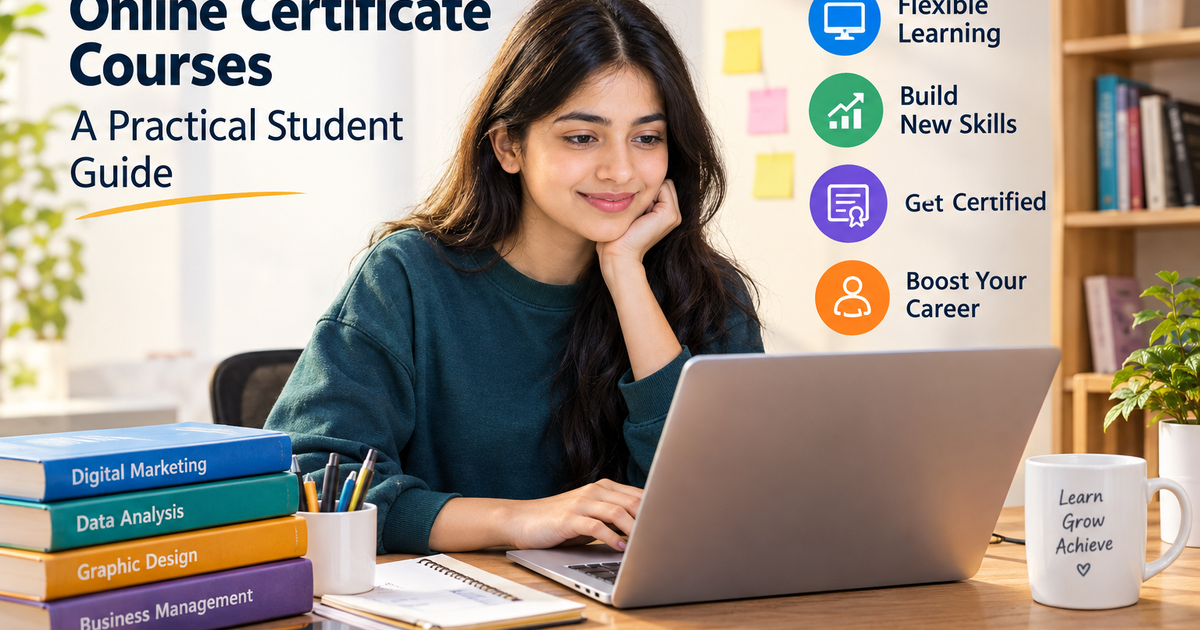
Learning outside the classroom is not always possible through a traditional classroom. These days, students and working professionals sign up for short-term courses that offer flexible timings without interrupting their current schedules.
Online Certificate Courses are for people who want to learn about something, improve what they already know, or even start learning in a field without having to undertake an entire long academic program.
But choosing a course can sometimes be difficult when there are many alternatives. When you are fully aware of the course content, learning format and duration, practical work to be done, and value of the course, it becomes easier to choose.
What Are Online Certificate Courses?
An online certificate course is a short-term computer-based program. They may cover all sorts of topics such as technology, business, marketing, finance, communication, or design.
Based on the course, you may get recorded lessons, live classes, assignments, quizzes, projects, and other learning content.
This certificate in itself is usually proof that a learner has finished and completed a specific course. The extent to which this information is useful depends on the course content, provider, subject, and just how relevant the learning is for a learner to pursue their objectives.
Online Courses: Why Do Students Take an Online Course?
Online learning is one of the options students and working professionals can consider.
Flexible Learning
Online courses give students the flexibility to study from home or anywhere else convenient for them. This can be useful for students juggling college, work, or other responsibilities.
Learning New Skills
Short courses are a way to explore a subject before committing to it more deeply.
Career Preparation
Other programs focus on practical knowledge, which can serve as a supplement to a student's previous education and help them prepare for specific work.
Convenient Access
Depending on the platform, a learner can access course materials on computers, tablets, or smartphones.
Choosing Affordable Online Certificate Courses
When it comes to choosing an online course, cost is one important factor. But the cheapest option does not always mean the best one.
Not all Affordable Online Certificate Courses include what you may expect. As a student considering an Affordable Online Certificate Course, look closely at the course and see beyond the price to make an informed decision about its overall value.
Consider factors such as:
- Course duration
- Number of lessons
- Live or recorded classes
- Assignments and projects
- Instructor support
- Learning materials
- Assessment methods
- Certificate requirements
A comparison of these details can give you a clearer picture of what you get as part of your course fee.
What Can You Learn Through Online Courses?
Online subjects offered are very general. Some common areas include:
- Digital marketing
- Data analysis
- Programming
- Graphic design
- Communication
- Business management
- Finance
- Project management
- Content writing
- Foreign languages
The decision you make will depend on your interests, what is taught in schools today, and what you wish to do with your life later.
Practical Learning Through Online Courses
Studying is not just reading or watching lessons. By working on assignments and projects, learners can understand how theories work in the practical world.
Practical Online Certificate Courses may involve projects, case studies, exercises, assessments, or other forms of practical work.
Before joining, see if the course offers opportunities to apply what you learn rather than only providing video lessons.
Skill Development and Career Preparation
Learning a new topic can help expand your professional development overall.
Professional Skill Development Courses can assist learners in practicing skills related to their interests or career progression.
For instance, if a student is studying marketing, they may acquire skills in content writing, social media, search engine optimization, or analytics. A technology enthusiast may concentrate on skills pertaining to programming, data, or software.
A course is only as good as the extent to which the skills it teaches align with the goals of the target learner.
Selecting the Right Course
Take your time to compare courses before taking one.
Check the Course Syllabus
Read the syllabus carefully. Check that the content is aligned with what you need to learn.
Understand the Learning Format
Find out if classes are live, recorded, or a mix of both. Think about which format best aligns with your schedule.
Look at the Course Duration
A very brief course might focus on introducing a subject, while a longer one may cover it in greater depth.
Check Practical Work
Look for assignments, projects, case studies, or other activities that allow you to put into practice what you have learned.
Understand the Certificate
See how the certificate is awarded and if completing the course or an assessment is mandatory.
Review Instructor Support
Getting support from instructors or mentors can make the learning process easier, especially if you have queries during the course.
Advanced Skill Development Courses
Students who have prior knowledge of a topic may also find it helpful to take Advanced Skill Development Courses.
More specialized in nature, these courses can cover niche subjects and might be beneficial to those who wish to enhance their proficiency.
But before signing up for an advanced course, learners need to do some homework. A course that assumes prior knowledge may not be suitable for someone starting from scratch.
Common Mistakes to Avoid
Making a decision based just on the name or certificate of the program can backfire.
Some common mistakes include:
- Not reading the syllabus
- Choosing only based on pricing
- Ignoring the course duration
- Not checking practical assignments
- Assuming all certificates hold equal value
- Not checking the learning outcomes
- Choosing an advanced course without a basic foundation
So, taking a few minutes to research these specifics can help you make a better decision.
Tips on Getting the Best Out of an Online Course
The first step is to enroll in a course. How you learn can greatly affect what you learn from it.
Establish a consistent study schedule and try to get submissions done on time. Note your learnings and make sure to revisit topics that you struggle with.
View the projects in your course as an opportunity to practice, not something you complete just to get a grade or certificate if projects are included as part of the course.
You may also keep samples of previous work, if applicable. These can be used to show what you learned when applying for future positions.
Online Certificates and Career Growth
An online certificate does not necessarily ensure a job or a promotion. It is a mix of knowledge, practical skills, experience, and how relevant this skill set is to the requirements of a particular role.
For learners, a certificate can complement academic education with another field of interest.
An online course can be a good option for working professionals or those looking to learn something new or freshen up their skills.
Final Thoughts
Online Certificate Courses can offer a flexible method of study for students and professionals who desire to acquire knowledge and skills. But the certificate alone should not be the sole reason for opting for a course.
Before finalizing a course, check its syllabus, learning format, practical work, duration, instructor support, and requirements for completion.
Select courses based on how much you can learn and practice, whether they are beginner courses or more advanced Skill Development Courses.
FAQs
What are Online Certificate Courses?
Online Certificate Courses are short-term learning programs conducted on the web. They can cover everything from technology and business to marketing and communication.
Can students find value in online certificate courses?
They can be helpful to students looking for additional subjects they want to learn, to develop skills, or to add to their current education.
What are the most important factors while choosing an online certificate course?
Before you enroll, find out the syllabus, duration of training, learning format, how much practical work is done, instructor support, assessment requirements, and certificate criteria.
Are online certificate courses expensive?
This can range quite a bit depending on the course. Students must compare the total fee with the course content, duration, support, and practical learning involved.
What are Skill Development Courses?
Skill Development Courses are programs designed to help learners build or enhance specific professional or practical skills.
Should beginners take advanced courses?
If you are a beginner, check the prerequisites first. Advanced courses may go a step further and assume that you know the basics.
Does an online certification get you a job?
No. It could show that you completed a course, but getting hired also depends on your skills, experience, qualifications, and the employer's requirements.